
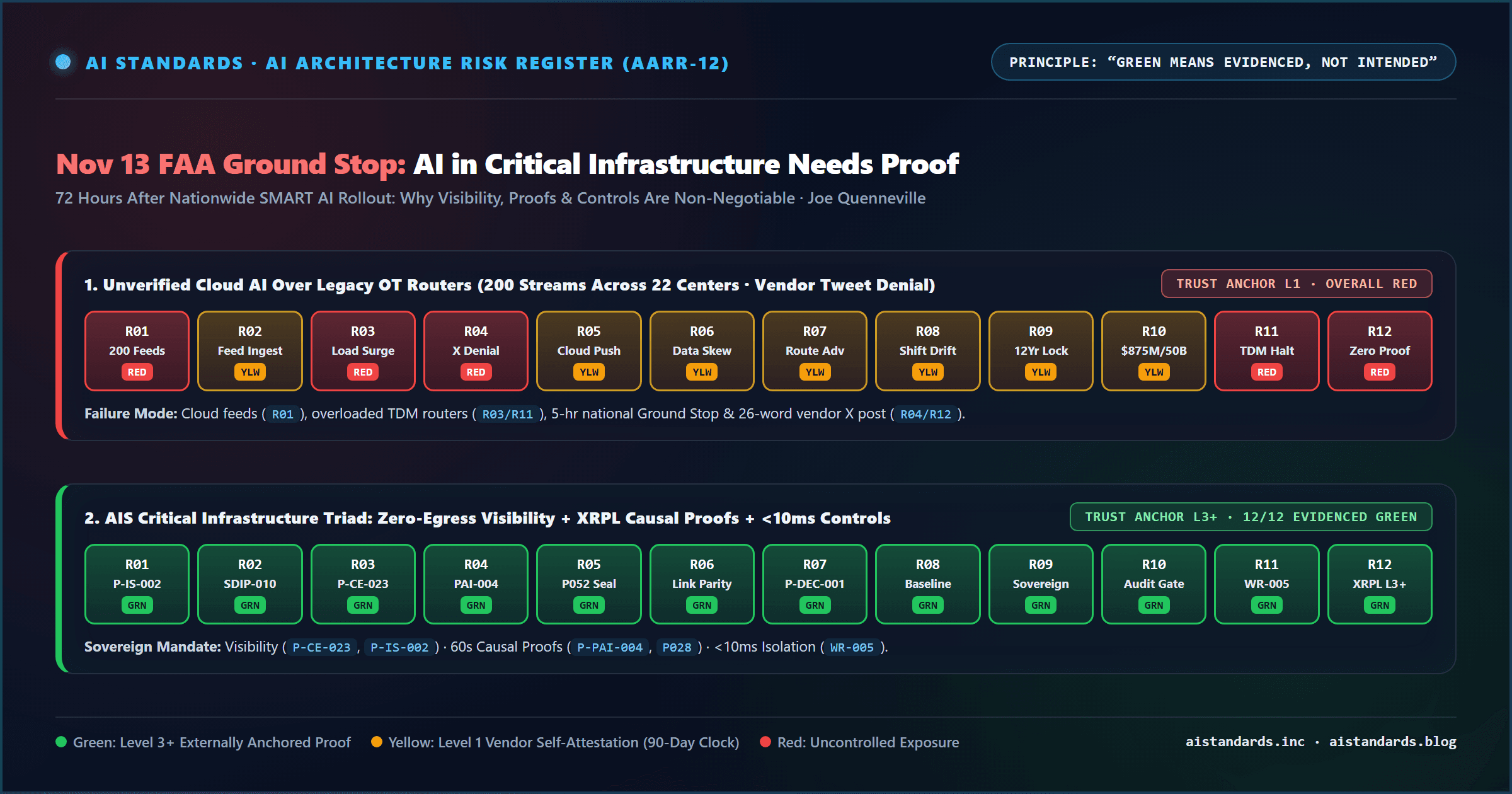
AIS AI Architecture Risk Register (AARR-12) Scorecard
Governing Principle: "Green Means Evidenced, Not Intended"
🔴 Unverified Critical Infrastructure AI Posture (TRUST ANCHOR LEVEL 1 - OVERALL RED): RED onR01(Cloud Ingestion of 200+ Live Operational Data Streams),R03(Unbounded Upgrade Load Overwhelming Legacy OT Routers),R04(26-Word Vendor Social-Media Self-Exoneration Instead of Causal Lineage),R11(Legacy TDM Switch Saturation Without Surgical Isolation), andR12($50B Public Infrastructure Spend Without Runtime Proof); 🟡 YELLOW onR02,R05,R06,R07,R08,R09,R10.
🟢 AIS Governed Critical Infrastructure Posture (TRUST ANCHOR LEVEL 3+ - 12/12 EVIDENCED GREEN): Zero-Egress Sovereign Nodes (P-IS-002) + Mathematical Flow-Conservation Bounds (P-CE-023) + Deterministic Pre-Execution Gates, Dual-Signed Human/AI Batons & Sub-10ms Circuit Breakers (P-DEC-001,P-PAI-004,P-SDIP-012,WR-005) + SHA-256 Weight Integrity Seals (P052) + Post-Quantum Zero-Knowledge Causal Proofs Anchored to XRPL (P028,P-TVS-007,P-QCS-001).
At 3:54 PM Eastern on Friday, November 13, 2026, more than 3,000 commercial aircraft were in the sky over the United States when the Federal Aviation Administration ordered a full nationwide Ground Stop on departing flights [1, 2]. By the time normal departures resumed nearly five hours later around 8:15 PM ET, over 11,000 flights had been delayed or canceled, paralyzing American commerce and marking only the third national airspace halt in U.S. history after September 11, 2001 and the January 2023 NOTAM outage [1, 2].
As a CEO who spends every week advising corporate boards, General Counsel, and infrastructure leaders on operational risk, what concerned me most on Friday night was not simply that aging hardware failed. It was the 72-hour sequence leading into the shutdown, and the glaring architectural contradiction inside the official explanations that followed.
1. Seventy-Two Hours From Nationwide AI Rollout to Nationwide Paralysis
Consider the verified timeline that played out in plain view this week:
- June & September 2026 (The $875M Cloud AI Contract): In June 2026, the FAA awarded a 12-year, $875 million modernization contract to aerospace software vendor Air Space Intelligence (ASI) covering Flow Management Data and Services (
FMDS) alongside SMART (Strategic Management of Airspace, Routes and Trajectories) - a cloud-based AI platform ingesting roughly200real-time data streams across weather, flight trajectories, schedules, and staffing [3, 4]. Regional testing began in Washington and Baltimore airspace on September 21, 2026 [3]. - Tuesday, November 10, 2026 (T-Minus 72 Hours): Transportation Secretary Sean Duffy and the FAA announced the nationwide expansion of SMART across all 22 Air Route Traffic Control Centers (ARTCCs) managing U.S. airspace [3, 4].
- Wednesday, November 11, 2026 (T-Minus 48 Hours): In televised remarks on AI governance and catastrophic risk, Microsoft co-founder Bill Gates warned that voluntary industry guardrails are falling short, adding candidly: "It may be that we have to suffer a few of the negatives before we respond as fully as we should" [5].
- Friday, November 13, 2026 (3:54 PM ET): Simultaneous telecommunications and data-consistency failures across multiple ARTCCs forced the FAA to halt departures nationwide for more than four hours [1, 2].
Now read the three statements delivered Friday evening side by side. At the White House briefing, Transportation Secretary Duffy attributed the halt to archaic analog Time-Division Multiplexing (TDM) telecom lines, stating that "switches and routers got overloaded with data... and started to give us inconsistency in the data from those routers," before asking Congress for a $50 billion appropriation to build a brand-new air traffic control system while admitting he could not guarantee another outage will not happen [1, 2]. Moments later, Homeland Security Secretary Markwayne Mullin confirmed there was no cyberattack, then delivered the decisive operational admission: the FAA had been integrating new equipment and technology upgrades that ultimately "overwhelmed the older system" [2].
Meanwhile, Air Space Intelligence posted a single 26-word denial from its official corporate X account (@AirSpaceIntel): "The current ground stop is not based on or a result of the SMART system, any product of ASI or our integration with FAA and ATC" [4]. So huge was the evidentiary vacuum behind that one-sentence post that a cybersecurity researcher's deadpan parody thread pretending to run ASI communications briefly fooled thousands of readers online.
2. Why Both Sides of Tonight's Debate Miss the Fiduciary Point
Responsible executives do not speculate beyond verified facts, and we do not claim SMART caused Friday's router failure. We do not need to. Every official statement on Friday night already convicts the underlying governance architecture:
- If SMART and recent upgrades had zero involvement: Why did the world's most strategic airspace rely on a 5-hour national shutdown and a 26-word vendor social-media post (Trust Anchor Level 1) instead of producing a 60-second cryptographic causal receipt proving which switch, feed, and software build diverged?
- If new high-volume upgrade integrations DID overwhelm legacy ARTCC routers (as DHS Secretary Mullin stated): Why was cloud-scale software rolled out across 22 national control centers without mathematical flow-conservation bounds and millisecond isolation circuit breakers sitting between modern software and 1980s copper-era telecom?
Worse, corporate boards and lawmakers are now being handed two false choices. On one side sits fatalism - the notion that society must "suffer a few of the negatives" or freeze AI modernization altogether. When 3,000 passenger jets are airborne, nuclear plants are balancing grid load, or hospitals are routing trauma care, "suffering a few negatives" is not a risk-management strategy; it is negligence. On the other side sits the blank check: pouring $875 million into cloud AI or $50 billion into new federal contracts without independent verification simply replaces slow legacy fragility with high-speed opaque fragility (see AI Strategy for Boards and the C-Suite).
3. Visibility, Proofs, and Controls: The Three Non-Negotiables for Critical Infrastructure AI
Whether you oversee federal transportation, an electric utility, a defense network, a clearing bank, or a hospital system, modernizing legacy operational technology (OT) with AI requires an independent verification layer modeled on ISO/IEC 17065 third-party impartiality [7]. Backed by 117 patent-pending applications - including our Physical AI and autonomous control-authority lineage filing (P-PAI-004, USPTO App. No. 64/198,408) - AI Standards (AIS) enforces three engineering requirements before any AI layer touches critical infrastructure (see Cybersecurity for Agentic AI and FedRAMP 20x and GovRAMP for AI Services):
1. VISIBILITY: Zero-Egress Flow Conservation Across Legacy Bridges (
P-CE-023&P-IS-002)
The Architectural Fix: When a 200-stream modern software layer meets aging analog orTDMrouting hardware, silent impedance mismatches corrupt downstream state long before an alarm rings. Running inside customer-owned, zero-egress Sovereign Stack nodes (P-IS-002, App. No. 64/149,857; see Local AI and the Test of Sovereignty), AIS enforces mathematical flow-conservation laws (P-CE-023, App. No. 64/192,942) and hardware-rooted Sovereign Device Integrity Proofs (P-SDIP-001..015) across every bridge.
Infrastructure Impact: Operators see packet saturation, latency skew, and state divergence in real time without streaming sensitive national-security telemetry into third-party commercial clouds.
2. PROOFS: A 60-Second Cryptographic Flight Data Recorder, Not Vendor Tweets (
P-PAI-004,P052&P028)
The Architectural Fix: Taxpayers, Congressional oversight committees, NTSB investigators, and enterprise insurers should never have to take a contractor's word on social media after a national outage. AIS binds every multi-stream input digest, SHA-256 Weight Integrity Seal (P052, App. No. 64/154,037; see Model Provenance and Weight Hashing), router link-quality attestation, and human operator handoff (P-PAI-004, App. No. 64/198,408) into post-quantum Zero-Knowledge compliance proofs (P-TVS-007, App. No. 64/149,863;P-QCS-001) anchored to sovereign ledgers and the XRP Ledger (XRPL) (P028,P060).
Infrastructure Impact: Delivers Trust Anchor Level 3+ root-cause proof in seconds while keeping classified airspace, grid, or financial payloads 100% private.
3. CONTROLS: Dual-Signed Human Authority Batons & Sub-10ms Surgical Isolation (
P-DEC-001&WR-005)
The Architectural Fix: Saying a human controller remains "in the loop" means nothing if corrupted router feeds poison their screen and leave a total national shutdown as the only emergency brake. Pairing ASIS deterministic pre-execution policy gates (P-DEC-001, App. No. 64/148,032; see Governing Enterprise Agent Workflows) with dual-signed human/AI control-authority batons (P-PAI-004,P-SDIP-012) and sub-10ms runtime circuit breakers (WR-005) isolates any degraded AI or upgrade feed in under ten milliseconds the instant link-quality parity drops.
Infrastructure Impact: Legacy primary channels stay clean, human operators retain uncorrupted command authority, and a localized data surge never cascades into a five-hour national Ground Stop.
4. A Fiduciary Mandate Before Signing the Next Modernization Check
America urgently needs to retire 1980s copper telecom and deploy modern intelligence across aviation, energy, water, defense, and financial clearing. What neither Congress nor any corporate board can afford is another unverified integration.
- For Congressional Appropriators & Agency Heads: Before authorizing $50 billion in air-traffic modernization, mandate independent Trust Anchor Level 3+ verification - Visibility, Proofs, and sub-10ms Controls - as a statutory procurement condition on every prime contractor and AI vendor.
- For Utility, Aviation, Healthcare & Financial Boards: Audit every interface where modern cloud AI or telemetry upgrades touch legacy OT and core routing against our
AARR-12standard (see SOC 2 With AI Systems in Scope). - Request an Executive Infrastructure Briefing: Review our independent governance standards at aistandards.inc/standards, inspect our zero-egress architecture at aistandards.inc/the-stack, or schedule a confidential briefing at aistandards.inc/executives.