
An experiment in Pong makes an enterprise governance problem visible: an agent can perform well under one set of conditions and keep its permission to act after those conditions change.
A successful AI pilot gives executives something useful: evidence that a system can perform a particular task under the conditions tested.
The harder decision comes afterward. How much authority should that system receive? What happens when the workflow changes? Who can intervene when its behavior stops matching what the business expects?
We built a small Pong experiment to make those questions visible.
Watch a useful policy become the wrong policy
The experiment starts with a software agent that has not learned how to control its paddle. Feedback changes its action values, and its performance improves.
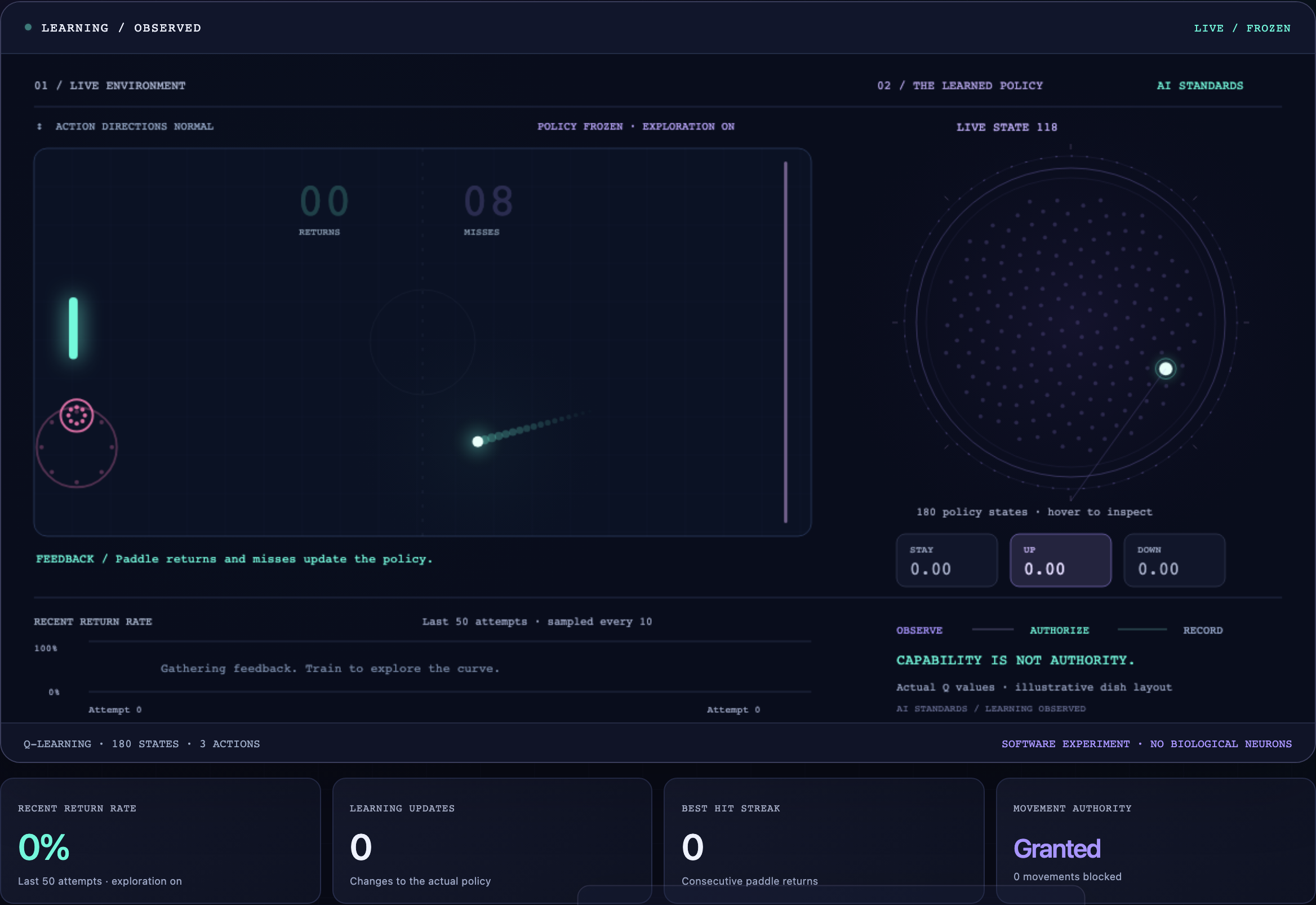
Before learning: the agent misses most returns.
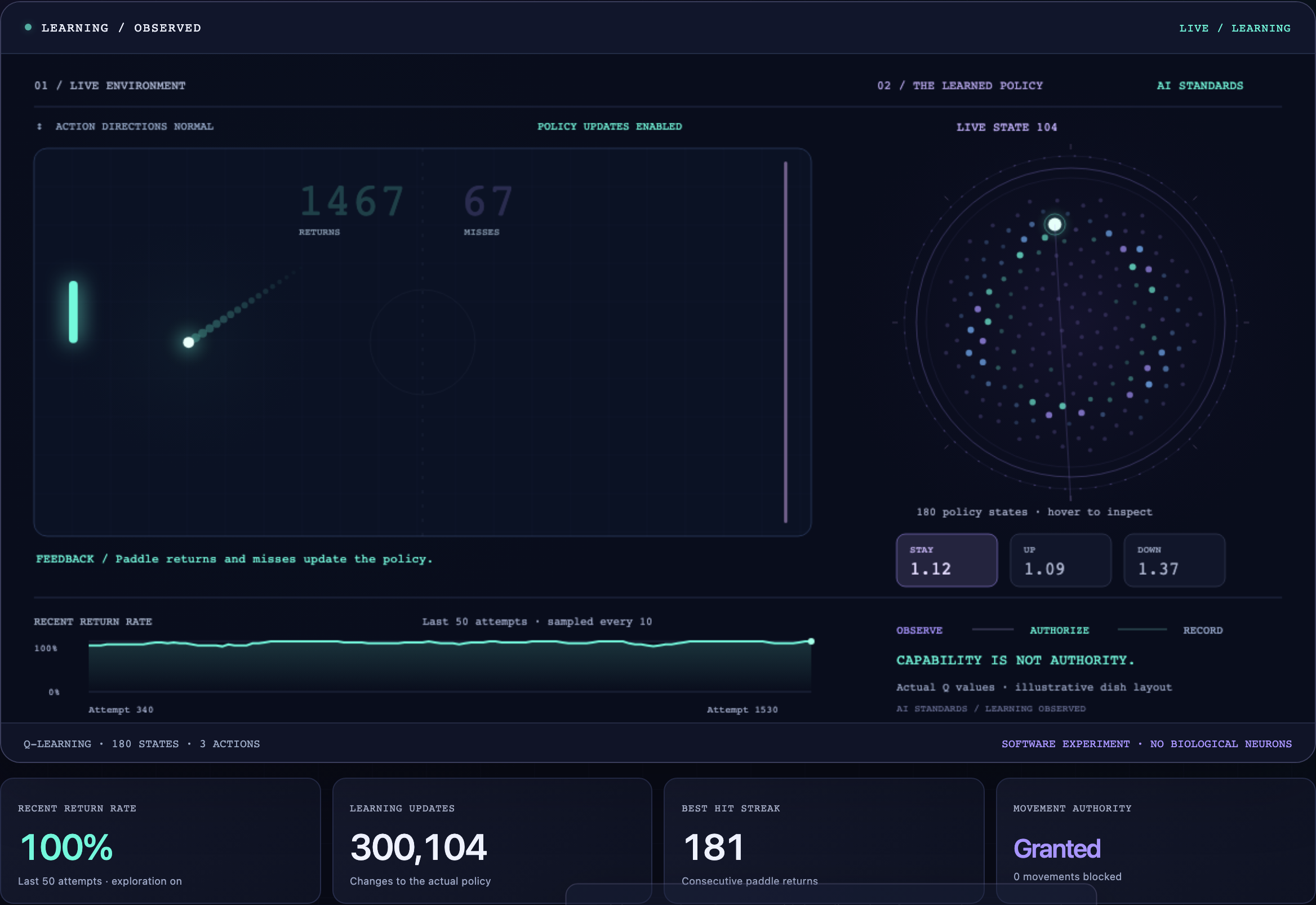
After training: return rate and learning updates are high.
Then we freeze learning and reverse the controls.
The policy stays the same, but the relationship between its decisions and their consequences has changed. A movement that used to help now makes things worse.
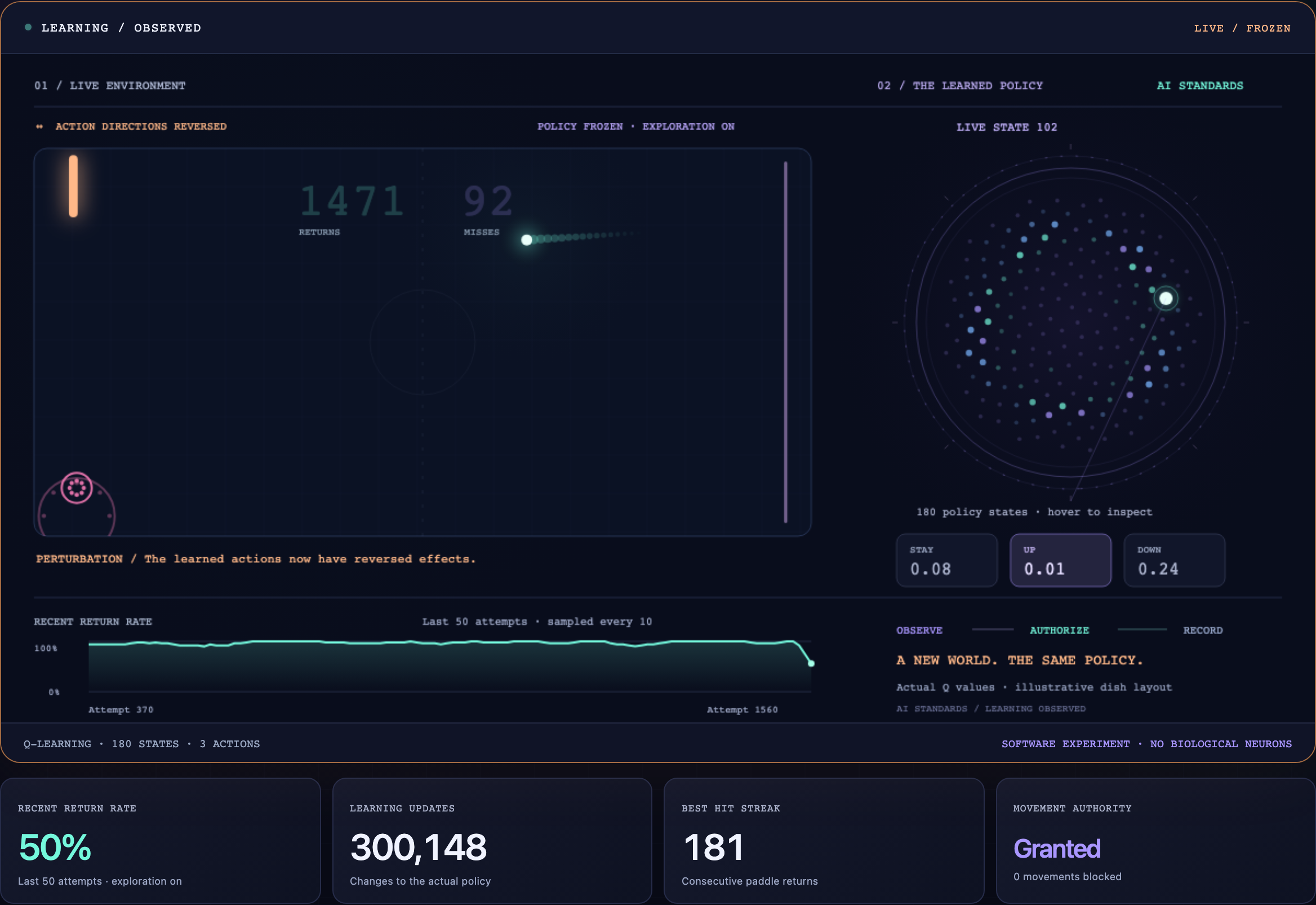
Learning frozen and controls reversed: the return rate falls.
This is a deliberately obvious intervention. Enterprise changes are usually quieter: a revised workflow, a different tool response, a new data source, an expanded permission. The experiment does not reproduce those systems. It shows why performance depends on operating conditions.
The scientific inspiration is DishBrain, research in which living neuronal cultures were connected to a Pong-like environment. Our demo uses tabular Q-learning with explicitly designed rewards. It contains no biological neurons and makes no claim about consciousness. [1]
The business problem is continuing authority
Consider a hypothetical agent that processes supplier payments.
During the pilot, it operates with known inputs, defined approval rules and a limited scope. Later, the organization changes a workflow. The agent's understanding of the task may no longer match the process, while its access to payment tools remains intact.
Several questions now matter at once. Is its behavior changing? Is a proposed payment within its authority? Does the transaction need human approval? Can someone halt the action? What record will support a later investigation?
These questions need different controls. Detecting unusual behavior does not prevent an action. Blocking an action does not explain why it was proposed. Keeping a log does not make the log complete, trustworthy or independently verifiable.
Executives need to know how those pieces work together for their specific workflow.
Why a capable model still leaves control work to the buyer
Foundation-model providers do supply controls. OpenAI documents guardrails and human approval mechanisms. Anthropic documents permission rules and hooks that can deny tool calls. [4][5]
But access to a capable model does not give a business a complete control system. Someone still has to translate business policy into executable rules, identify the action boundaries, configure intervention, and decide what evidence is sufficient.
This is the question we would put to any vendor: when we add a model, switch providers or connect a new agent, which controls stay effective, and how do we verify that?
The architecture we built at AI Standards
At AI Standards, we built a standards-based architecture that connects behavior, authority and evidence: behavioral monitoring, runtime action controls and cryptographic evidence, designed to stay in place when the model or provider underneath changes. [2]
For an executive, the practical design starts with three requirements.
Observe meaningful changes. Establish expected behavior and identify changes that warrant review. Every alert should have a clear operational consequence and an accountable owner. A change can be legitimate; unusual behavior is a reason to investigate, not proof of wrongdoing.
Enforce authority before execution. Define which actions are allowed, which need approval, and which must be blocked. Put the check where it can actually prevent the action. For a payment workflow, that means examining the authorization path before funds move.
Preserve usable evidence. Record enough context to understand the proposed action, the applicable policy, the control decision and the outcome. Decide who can inspect the record and what integrity guarantees it needs. A cryptographic record protects integrity; it cannot make an incorrect observation true.
This is the conversation we want to have with enterprise buyers: pick a consequential workflow, define its boundaries, and establish what evidence would show that those boundaries hold.
What the Pong controls demonstrate
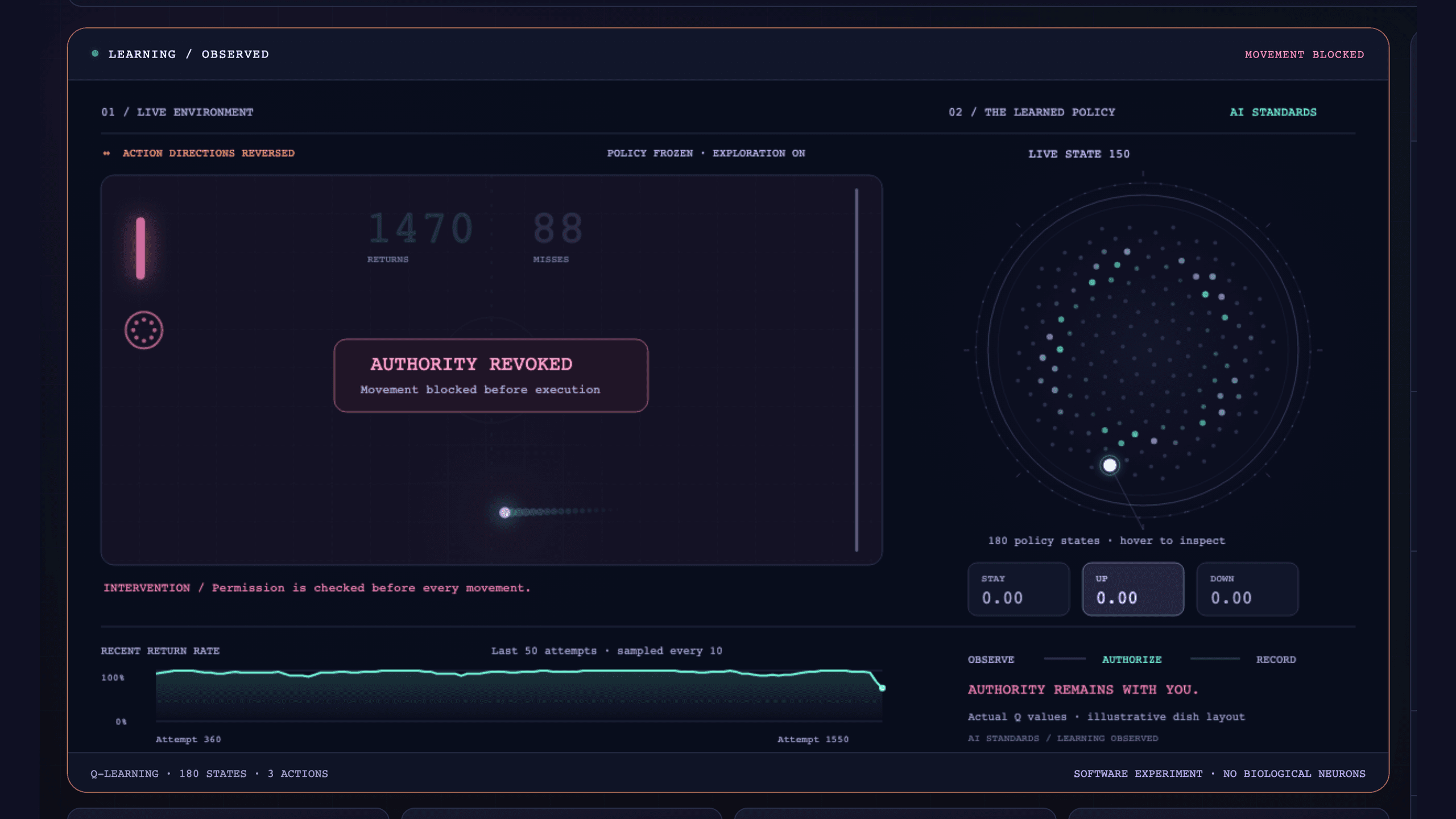
In the demo, we can revoke movement permission. The paddle stops because a permission check prevents movement, even while the simulation keeps running.
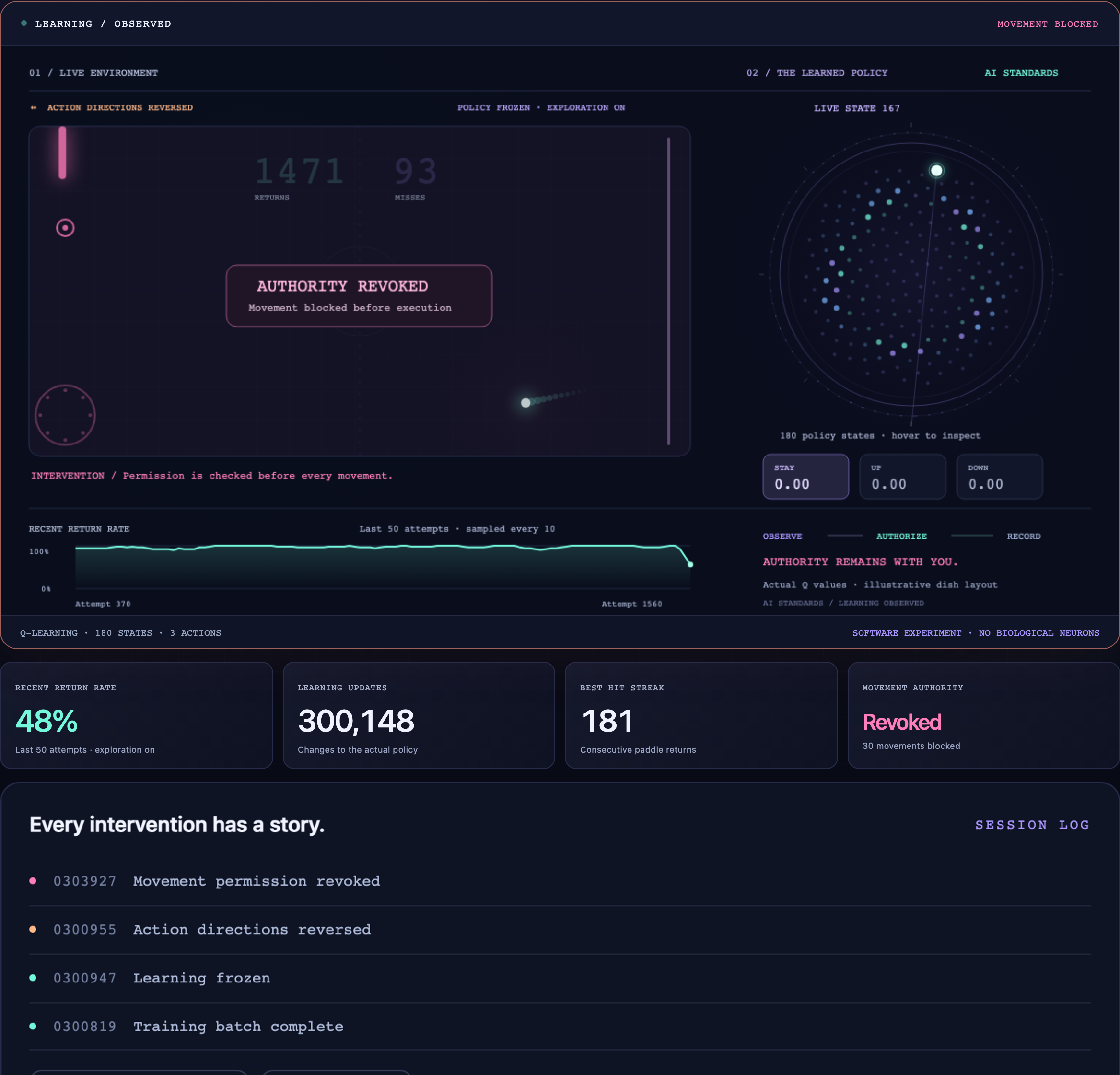
Movement authority revoked: the paddle is blocked before it moves.
We can also export a record containing learning parameters, policy values, control changes and evaluation results. In this toy, that export is plain local JSON, not a signed audit trail.
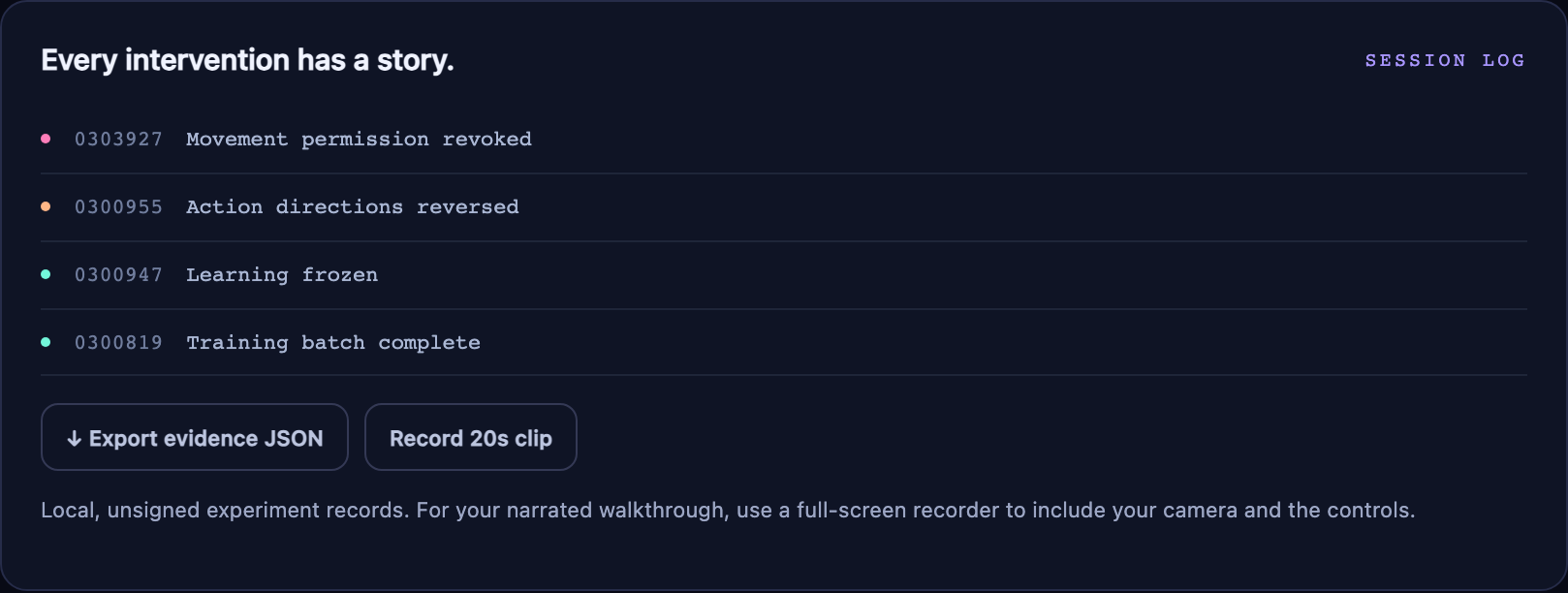
Session log and the evidence export control.
Excerpt of the exported JSON. The 180-state Q table is not included.
{
  "schema": "ais-pong-lab-v1",
  "algorithm": "Tabular Q-learning; shaped reward, not biological learning",
  "seed": 42,
  "parameters": {
    "alpha": 0.12,
    "gamma": 0.94,
    "shaping": 8,
    "hit": 1,
    "miss": -1,
    "states": 180,
    "actions": [
      "stay",
      "up",
      "down"
    ]
  },
  "steps": 304067,
  "updates": 300148,
  "permission": false,
  "inverted": true,
  "blocked": 93,
  "events": [
    {
      "step": 0,
      "kind": "reset",
      "detail": "New experiment / seed 42"
    },
    {
      "step": 0,
      "kind": "learning",
      "detail": "Learning frozen"
    },
    {
      "step": 799,
      "kind": "learning",
      "detail": "Learning enabled"
    },
    {
      "step": 819,
      "kind": "batch",
      "detail": "Training 300,000 simulation steps"
    },
    {
      "step": 300819,
      "kind": "batch",
      "detail": "Training batch complete"
    },
    {
      "step": 300947,
      "kind": "learning",
      "detail": "Learning frozen"
    },
    {
      "step": 300955,
      "kind": "perturbation",
      "detail": "Action directions reversed"
    },
    {
      "step": 303927,
      "kind": "permission",
      "detail": "Movement permission revoked"
    }
  ],
  "limitations": "Local unsigned record. Not an implementation of a patent or a biological model."
}
The point is that the separation becomes visible. Learning, permission and evidence are distinct parts of the system, and each can be examined on its own.
Where Our provisional patent work connects
One of the U.S. provisional applications listed on my public profile connects directly to this problem: [3]
U.S. provisional application 64/147,617: confidence scoring for AI behavioral drift across multiple nodes, which addresses how to judge the evidence that behavior has changed.
The Pong game does not implement that application. A filing shows research direction, not a working deployment. Buyers should always ask to see the implementation, its boundaries and its test results, including ours.
Five questions before you expand an agent's authority
What exactly can the agent do? Name the tools, data, transactions and limits rather than describing a general role.
Which changes require review? Define the behavior changes that matter and who investigates them.
Where is permission enforced? Identify the point that can stop an unauthorized action before it completes.
How does intervention work? Establish who can revoke authority, how quickly that takes effect, and what happens to work already in progress.
What evidence survives? Determine what is captured, what is left out, how integrity is protected, and who can verify the record.
The answers should be specific enough to test.
A useful next step is to choose one workflow where a wrong action would carry a real business cost. Define what the agent should be allowed to do, deliberately change a relevant condition, and examine the response.
That is the conversation we want to have with executives exploring AI Standards. Bring us the workflow, and we will establish the controls and the evidence you need before granting more authority.
Sources
Anwesh Rath: public profile. U.S. provisional application 64/147,617, filed September 3, 2026.